

Businesses often use the words recruitment and outsourcing interchangeably, but they describe different services. Recruitment focuses on finding and selecting people for jobs. Outsourcing involves transferring a business activity, process, or workforce responsibility to an external provider.
Understanding the difference can help organisations choose the right solution for permanent hiring, temporary staffing, project support, or long-term workforce management.
What Is Recruitment?
Recruitment is the process of attracting, evaluating, selecting, and hiring candidates for available positions. It may be managed by an internal HR team or supported by an external recruitment agency.
A typical recruitment process includes:
- Understanding the vacancy and job requirements.
- Preparing a job description.
- Advertising the role or searching for candidates.
- Reviewing applications and resumes.
- Conducting interviews or assessments.
- Checking references and documents.
- Selecting the preferred candidate.
- Issuing an offer and supporting onboarding.
The main objective is to find the right person for a particular job. Recruitment may be used for permanent, temporary, contract, executive, technical, or entry-level positions.
For example, a manufacturing company may engage a recruitment agency to hire a production supervisor, maintenance technician, quality engineer, or warehouse manager. The agency sources and screens candidates, while the final employee generally joins the manufacturing company’s payroll.
What Is Outsourcing?
Outsourcing means assigning a business function or activity to an external organisation instead of managing it entirely in-house. Companies outsource work to obtain specialist expertise, reduce administrative pressure, improve efficiency, control costs, or focus on their core business.
Common outsourced functions include:
- Payroll processing.
- Accounting and finance.
- IT support.
- Customer service.
- Logistics.
- Facility management.
- Security.
- Recruitment.
- Production activities.
- Data entry and administration.
Outsourcing is broader than recruitment. It may involve an entire process, department, project, or workforce activity rather than simply filling vacancies.
For example, a company might outsource its payroll administration to a specialist provider. In that arrangement, the provider manages payroll calculations, records, compliance support, and reporting. The provider is not merely recruiting a payroll executive; it is delivering the payroll function.
Recruitment and Outsourcing Compared
| Area | Recruitment | Outsourcing |
|---|---|---|
| Main purpose | To find and hire people | To transfer a business activity to an external provider |
| Primary focus | Candidates and vacancies | Processes, services, projects, or workforce operations |
| Typical outcome | A person is hired | A service or function is delivered |
| Ownership | Client usually manages the employee after hiring | External provider may manage the process or assigned workforce |
| Duration | Often linked to a specific vacancy | Can be short-term, ongoing, or project-based |
| Examples | Hiring an engineer or sales executive | Outsourcing payroll, logistics, customer support, or production |
| Payment model | Placement fee, retainer, or recruitment charge | Monthly fee, project fee, hourly charge, or service contract |
| Success measure | Quality and speed of hire | Service quality, efficiency, compliance, and performance |
How Recruitment Works
Recruitment can be handled internally or through a recruitment agency.
Internal recruitment
An in-house HR or talent-acquisition team manages the complete hiring process. This model may be suitable for companies with regular hiring requirements, established employer branding, and sufficient recruitment expertise.
Agency recruitment
A recruitment agency supports the employer with some or all hiring activities. Agencies may provide:
- Candidate sourcing.
- Resume screening.
- Technical pre-screening.
- Interview coordination.
- Reference checks.
- Salary-market information.
- Offer support.
- Joining follow-up.
Traditional recruitment agencies are often engaged for individual vacancies or defined groups of roles. They typically deliver shortlisted candidates, while the client retains control over selection and employment.
How Recruitment Outsourcing Works
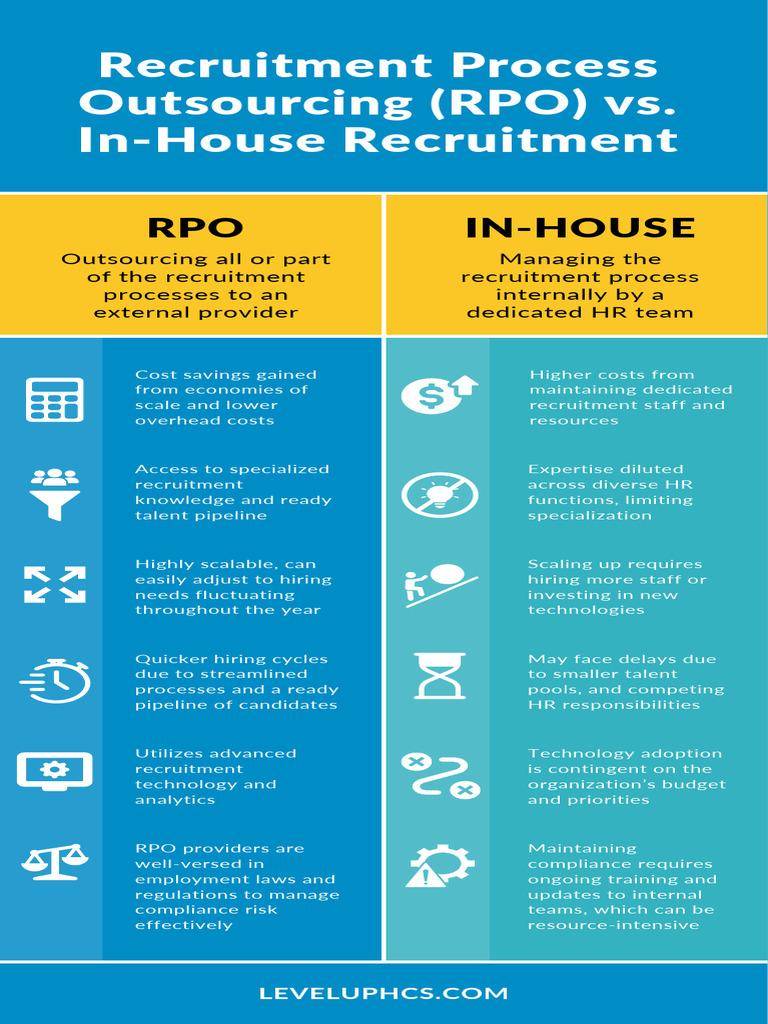
Recruitment outsourcing is commonly known as Recruitment Process Outsourcing, or RPO. In an RPO arrangement, an organisation transfers part or all of its recruitment process to an external provider. The provider generally works as an extension of the internal HR team rather than operating only as a source of individual candidates.adecco+1

An RPO provider may manage:
- Recruitment planning.
- Employer branding.
- Job advertising.
- Sourcing and talent mapping.
- Applicant tracking.
- Candidate screening.
- Interview scheduling.
- Offer management.
- Recruitment reporting.
- Onboarding coordination.
RPO is usually more strategic and ongoing than traditional agency recruitment. It may be appropriate for companies experiencing rapid growth, high-volume hiring, multiple locations, or a shortage of internal recruitment resources.
Recruitment vs Staffing Outsourcing
Another important distinction is between recruitment and staffing outsourcing.
In recruitment, the candidate is usually hired directly by the client. In staffing, the agency may employ workers and assign them to work at the client’s site. Staffing is commonly used for temporary, contract, seasonal, project-based, or flexible workforce requirements.viva-it+1
For example:
- A company recruits a permanent HR manager through an agency.
- A staffing provider supplies 50 temporary warehouse workers for six months.
- A recruitment outsourcing partner manages the company’s entire hiring process.
- An outsourcing company operates the customer-service department on behalf of a client.
In staffing arrangements, the provider may manage payroll, attendance, statutory documentation, and certain employment responsibilities. The precise arrangement depends on the contract and applicable employment laws.
Advantages of Recruitment
Recruitment is particularly useful when a company needs to fill specific positions while retaining control over the final hiring decision.
Key benefits include:
- Access to a wider candidate pool.
- Faster sourcing for difficult vacancies.
- Specialist knowledge of particular industries.
- Reduced workload for internal HR teams.
- Better access to passive candidates.
- Support with technical and executive hiring.
- Improved recruitment organisation.
- Greater flexibility during hiring peaks.
Recruitment is often the best option when a company has a limited number of vacancies or needs specialist support for roles that are difficult to fill.
Advantages of Outsourcing
Outsourcing may be more suitable when a company needs an external provider to manage an ongoing function or large-scale activity.
Benefits can include:
- Access to specialist expertise.
- Lower internal administrative workload.
- Flexible workforce capacity.
- Improved process consistency.
- Potential cost control.
- Faster implementation.
- Better access to technology.
- Ability to focus on core business operations.
For example, a growing manufacturer may outsource payroll, security, transport, or temporary workforce management while its internal team focuses on production and business development.
Advantages of Recruitment Outsourcing
RPO combines recruitment expertise with process management. It can be valuable for businesses with frequent or high-volume hiring requirements.
An RPO partner can help with:
- Building continuous talent pipelines.
- Managing multiple job requisitions.
- Improving time-to-hire.
- Standardising screening and interviews.
- Strengthening employer branding.
- Tracking recruitment performance.
- Expanding hiring across locations.
- Managing seasonal workforce demand.
The provider may also integrate its recruiters and technology with the client’s HR team and systems. This creates a more consistent hiring experience for both candidates and managers.
Which Option Is Right for Your Business?
The right solution depends on the company’s hiring volume, urgency, internal capabilities, workforce model, and long-term goals.

Choose recruitment when:
- You need to fill one or several specific vacancies.
- Your HR team manages the overall hiring process.
- You want to retain direct control over employment.
- You need specialist support for technical or senior positions.
- You require a shortlist rather than a complete outsourced function.
Choose staffing outsourcing when:
- You need temporary or contract workers.
- Demand changes seasonally.
- You require rapid workforce expansion.
- You want support with payroll or workforce administration.
- The roles are project-based or time-limited.
Choose RPO when:
- You hire regularly throughout the year.
- You are expanding into new locations.
- Your internal recruitment team lacks capacity.
- You need to manage large numbers of vacancies.
- You want a long-term talent-acquisition partner.
- You need better recruitment reporting and process control.
How MVS Recruitment Can Help
MVS Recruitment can support businesses with practical recruitment and workforce solutions tailored to their requirements. Depending on the client’s needs, support may include permanent recruitment, contract staffing, technical hiring, high-volume recruitment, candidate screening, and recruitment-process support.
A suitable recruitment partner should understand the client’s industry, work environment, technical requirements, salary expectations, location, and workforce challenges. It should also communicate clearly with candidates and employers throughout the hiring process.
Before choosing a provider, businesses should confirm:
- What services are included.
- Whether candidates join the client’s or provider’s payroll.
- Who manages compliance and documentation.
- How fees are calculated.
- What replacement or guarantee terms apply.
- Which recruitment metrics will be reported.
- How candidate data will be protected.
- Who makes the final hiring decision.
Frequently Asked Questions
What is the simple difference between recruitment and outsourcing?
Recruitment means finding and hiring people for jobs. Outsourcing means giving a business activity or process to an external provider. Recruitment is focused on filling positions, while outsourcing is focused on delivering an ongoing service or function.
Is recruitment agency service a type of outsourcing?
It can be considered a form of outsourced recruitment because an external agency performs part of the hiring work. However, traditional recruitment is usually role-specific, while Recruitment Process Outsourcing involves broader responsibility for managing the recruitment process.
Who employs workers supplied through staffing outsourcing?
In many staffing arrangements, the staffing provider employs the workers and assigns them to the client. In permanent recruitment, the selected candidate generally joins the client’s payroll. The contract should clearly define employment, payroll, compliance, and supervision responsibilities.
Is outsourcing cheaper than recruitment?
There is no universal answer. Recruitment may be more economical for a few vacancies, while outsourcing may provide better value for high-volume or recurring requirements. Businesses should compare total costs, including administration, time, technology, compliance, turnover, and productivity.
Should a small business choose recruitment or outsourcing?
A small business with occasional vacancies may benefit from recruitment support. If it needs temporary workers, payroll administration, or an entire non-core function, outsourcing may be more suitable. The decision should be based on the business activity being transferred and the level of control required.
Conclusion
Recruitment and outsourcing solve different business problems. Recruitment helps organisations identify and hire suitable employees, while outsourcing transfers a process, service, project, or workforce responsibility to an external provider.
Traditional recruitment is generally ideal for specific vacancies. Staffing outsourcing is useful for temporary and flexible workforce requirements. Recruitment Process Outsourcing is better suited to businesses that need ongoing, large-scale, or strategically managed hiring.
By understanding these differences, companies can select the right model, control costs, improve hiring outcomes, and focus their internal resources on business growth.